Roof insulation
The right insulation and mineral wool make your home warm and comfortable. Insulating the walls, floors and ceiling prevents unnecessary heat loss. We offer insulation from manufacturers such as Ursa and Isover.
Categories

Products (10)
- Isover Eurostyr 30
- Isover Eurostyrdach
- Isover flat roofs, floors built using wet construction methods and foundations
- Isover pitched roof insulation rolls
- Swisspor Biterm insulation boards (bitumen-faced EPS)
- Swisspor tapered EPS insulation
- Thermano flat roof insulation
-
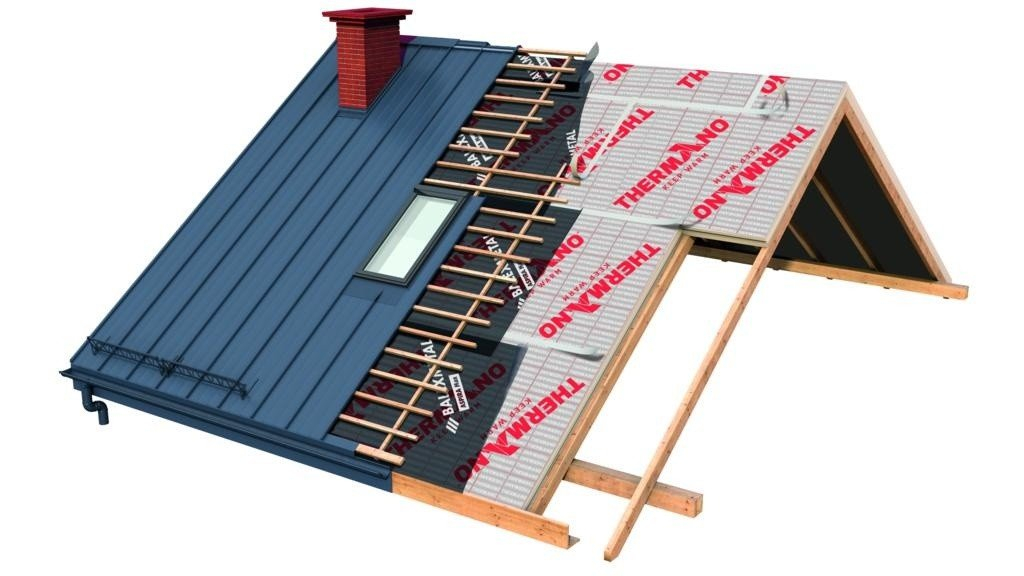 Thermano pitched roof insulation
- Ursa insulation boards
- Ursa insulation rolls
Energy efficiency is one of the most important considerations when designing buildings. Highly effective thermal insulation systems are crucial. Careful planning and correct installation techniques also play a major role. Remember that insulation adds load to the roof structure. The insulating material should therefore be light enough to avoid overloading an existing roof or requiring a massive, expensive roof structure in a new building.
Insulating a home from above, at the roof or flat roof above the highest heated floor, makes sense because warm air rises. It costs the least and brings the greatest benefits. It is also usually the easiest insulation to install, even in an existing home. Insulation of the roof slope determines the stability of the loft's indoor environment, including temperature, humidity, ventilation and acoustics, and therefore the comfort of its living spaces. A useful principle is that more insulation is better. The insulation thickness needed for good thermal performance depends on the rafter depth. With standard rafters, one solution is two layers of insulation, fitted between and beneath them. For flat roofs, dual-density insulation boards can replace a two-layer system. This gives the insulation very high mechanical strength throughout, rather than just in the top layer as in a two-layer system.
- high thermal performance,
- continuous thermal insulation without thermal bridges: the material should fill the insulated space precisely and adjoining sections should fit tightly together,
- effective moisture protection for the entire roof assembly, including the insulation and roof structure,
- windtightness that prevents outside air from entering and warm air from being blown out of the insulation, while allowing water vapour to escape effectively,
- non-combustibility, forming a fire barrier and preventing fire spread,
- good acoustic properties,
- easy installation.
- stone wool (rock wool)
- glass wool
Stone wool (rock wool)
Mineral wool is an insulation material of mineral origin. It is used for thermal and acoustic insulation of external and internal walls, floor slabs and floors, pitched and flat roofs, and service runs. It also forms the insulating and structural core of building sandwich panels. Mineral wool is usually made from basalt, melted at +1400°C and then spun into fibres. A binder is added to the resulting stone fibres. The fibres are also treated to make them water-repellent, so mineral wool products do not absorb water. The material is made into boards, felts, mats, pipe sections or granules. Depending on the product, bulk density ranges from 20 kg/m³ for mineral wool granules to 180 kg/m³ for the hardest boards.
- thermal insulation (low thermal conductivity),
- non-combustibility and fire resistance,
- sound absorption,
- stability of shape and dimensions,
- resilience and mechanical strength,
- biological and chemical resistance,
- water resistance and vapour permeability.
Glass wool
Glass wool is an insulation material of mineral origin used at temperatures up to 700°C. Its properties, production technology and applications are similar to stone wool. Glass wool is made by melting quartz sand and recycled glass at 1000°C, with added rocks such as gabbro, dolomite or limestone. The molten material is spun into fibres, to which a binder is added. Boards, mats, pipe sections (lamella mats faced with impregnated paper or aluminium foil) and loose granules are used for thermal and acoustic insulation. Bulk density ranges from 20 kg/m³ to 150 kg/m³. Glass tissue products are used as reinforcement in some types of roofing felt.
- glass wool materials provide warmth without taking up much space,
- the resilience of the fibres allows glass wool to fill any space and adapt to the structure,
- the lightweight product adds very little load to the roof structure, is easy to transport to site and can be fitted easily without complicated equipment,
- the structure of glass wool allows moisture to move properly, preventing mould and fungal growth and letting the roof assembly breathe,
- glass wool provides excellent acoustic insulation,
- glass wool is non-combustible.
Insulating 150 m² of pitched roof on an average residential building with glass wool products adds 450 kg to the roof structure, while the lightest stone wool boards add around 900 kg.
Increasing thermal insulation thickness from 5 to 15 cm will repay the investment in less than a year.
Roof insulation manufacturers
Many types of roof insulation are available on the Polish market. Our range includes the best products from leading roof insulation manufacturers:- Thermano
- Ursa
- Isover
The mineral wool we offer comes with a guarantee lasting many years. Ambit's specialists will be happy to help you choose the best roof insulation. They will advise you on which material to use for your roof and how to use it correctly, giving you a thorough understanding of the product you buy.

Contact your nearest branch
Ambit branch 4D Grupa network partner