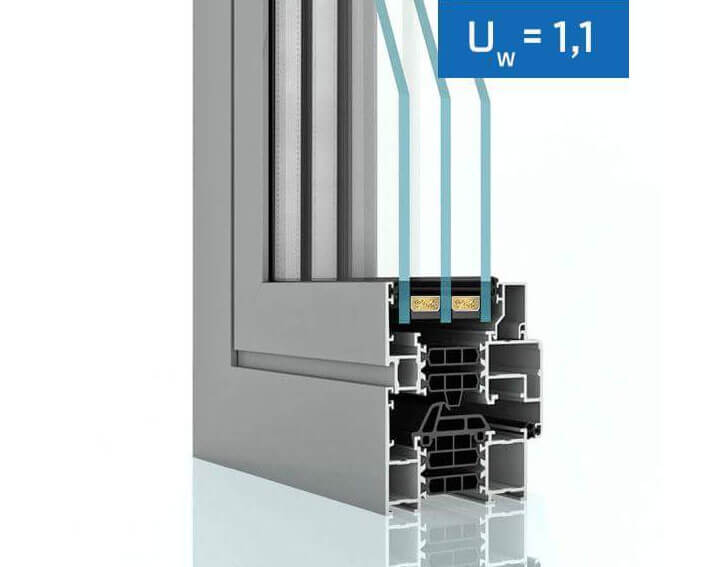
Thermal transmittance is one of the most important criteria when choosing windows for your home. It describes their thermal insulation and directly affects your home’s heating bills. I will explain what it is, what this value tells us, why it matters and how to compare it.
This coefficient is said to determine how warm the inside of your home will be. Windows with poor insulation cause unnecessary heat loss, which means higher heating costs in practice. Is this the only reason why so much emphasis is now placed on thermal transmittance?
What is thermal transmittance?
Thermal transmittance, or Uw tells us how much heat is lost through a given thermal barrier. Here, we are talking about the value for the entire window structure. The lower the Uw value declared by the manufacturer, the lower the heat loss. However, the higher it is, the better the window’s thermal insulation.
Every manufacturer declares the thermal insulation value of its windows. Some have something to be proud of. Today’s windows achieve very high values. For example, our range includes Dako timber-aluminium windows with Uw = 0,65 W/m²K. This is the value for a window with a 4-pane glazing unit in the reference size (1230 x 1480 mm). Window size matters when comparing different products.
By contrast, Uw = 1,5 W/m²K (!) was once standard. Combined with very careless installation and a lack of adjustment, it was associated with fluttering curtains and excessive air circulation in the house.
Why the trend towards ever better values?
Is it only about saving on heating? Yes and no. We all want to save. Regulations also encourage us to do so. New technical requirements came into force on 1 January 2017, changing the required window specifications. The requirements for thermal transmittance Uw, which is to be progressively reduced under the Regulation of the Minister of Infrastructure, have changed.
Remember that from 2014, façade windows could be installed in buildings with Uw not exceeding 1,3 W/m²K. In 2017, the requirements were tightened to 1,1 W/m²K. The next stage will be the changes in 2021, when the required value will be Uw = 0,9 W/m²K. Remember that the stated values apply to a window in the reference size.
This means that many products available today will need further development or disappear from the market altogether. Shortly, we will explain how to choose the best quotation and buy windows that meet our expectations and comply with applicable regulations. Before that, let us find out where the coefficient comes from.
How is thermal transmittance calculated?
Many factors affect a window’s thermal insulation. These include the number of panes, the gas filling between them, window size, pane thickness, profile thickness, the number of chambers in the profile or the quality of the timber, the type and number of seals, and the often overlooked installation method. Find out more: How is thermal transmittance calculated?
For this article, we have prepared example calculations for windows of different areas. Interestingly, windows of different sizes made using the same technology will have completely different values. Let us take Dako DDF78 timber windows as an example: the reference size (with a window area of 1,82m²), with three panes, achieves Uw = 0,89 W/m²K. The same profile with different window areas can achieve the following example values:
- 0,9 m² - 1,2 W/m²K
- 1,3 m² - 1,0 W/m²K
- 2,0 m² - 0,98 W/m²K
- 3,3 m² - 0,96 W/m²K
- 4,8 m² - 0,89 W/m²K
- 9,9 m² - 0,85 W/m²K (!)
At first glance, the larger the window, the better its performance. This is due to the glazing’s very high insulation. It is not an absolute rule, as many other factors affect the value, such as how the window opens, whether it is divided or whether it is fixed. The last value, for a very large fixed window, is particularly surprising: its performance is considerably better than that of the reference window.
What should you look for when choosing windows?
In the example above, based on an actual house design, the declared values were achieved for 2 out of 6 windows. Our customers always receive a complete window schedule with thermal transmittance calculated separately for each window. This is very important when we want the best value. It lets us examine the quotation closely and optimise it further, changing the construction where possible or using a better-insulated glazing unit.
The most common mistake is to compare a quotation with products from another manufacturer where every product, regardless of size, has a very high value, usually that of the reference window. This sets alarm bells ringing: something is wrong. Unfortunately, we see such quotations quite often.
There have even been cases where a manufacturer did not state the window’s thermal transmittance, only that of the glass. Why? Because these values are much higher. As we already know, the glass has the best performance in the entire window and contributes most to its high performance. Unaware of being misled, the client thought they had received an excellent quotation for highly energy-efficient windows with a value of 0,6 W/m²K. Frankly, I do not know whether the whole window can achieve this value at present. At the time of writing, our best window achieves 0,65 W/m²K.
Only a quotation with different thermal transmittance values for different window sizes is reliable. Check how much the values differ from those declared. The window value and the glass value are two completely different figures. If only one is given, that should also set alarm bells ringing.
We are confident in the quality of the windows we offer
Thermal transmittance guides your window purchase. We, in turn, are confident in the high quality of the windows we supply. Consider windows with higher energy performance. Among PVC windows, we recommend DPQ-82 thermo for maximum energy efficiency. If you dream of a classic, natural look and prefer timber windows, consider the DDF-92 and DDR-92 series. If you are building a modern house with a minimalist look and a simple, austere structure, we recommend aluminium windows from the DA-90 series, with excellent thermal performance.
A misconception: thermal transmittance and “warm” installation
Finally, I would like to draw attention to installation. We offer our customers windows with high thermal transmittance values. We know they want high insulation performance. We believe that, when choosing high-quality windows, they are also committed to professional “warm” installation. We therefore offer “warm” installation using the necessary insulating components.
The biggest mistake you can make when buying expensive windows is to economise on installation. It is serious enough that I would venture to say that mid-range windows fitted properly using “warm” installation will be warmer than the warmest windows fitted without it. Thermal bridges most often occur where two different building materials meet, for example between a wall and a window. What use are excellent windows if thermal bridges around them cause the room to cool down? That is why I believe “warm” installation is essential for energy-efficient windows.
Questions about your roof?
An adviser will review your plans and choose materials to suit your budget.