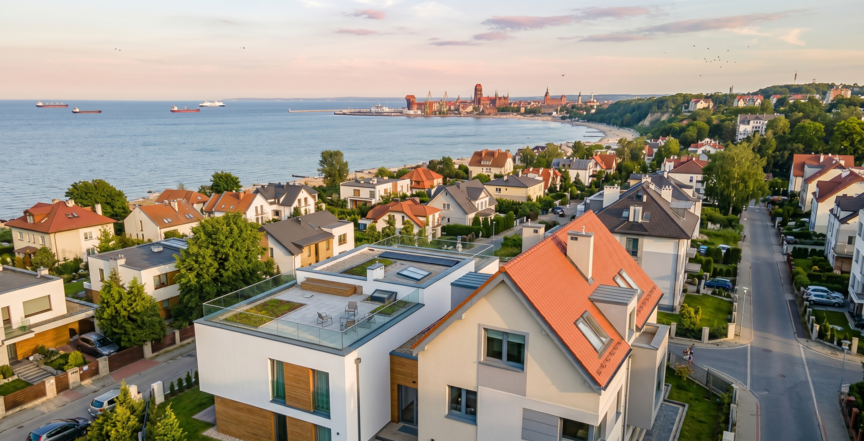
A flat or gable roof in Trójmiasto?
How to choose a solution suited to the plot, design and climate
Choosing the roof shape is more than a visual decision. It affects the top floor layout, construction costs, drainage, photovoltaic installation options, later maintenance and the durability of the whole building element.
The answer to “flat or gable roof?” depends on the plot, MPZP local development plan provisions, budget and expectations for the house. Gable roofs remain very popular because they are simple, proven and drain water well. Flat roofs gain favour when clients want a modern building form, a fully usable floor without sloping ceilings, a roof terrace or convenient space for technical installations. In Gdańsk, the local development plan is local law and underpins administrative decisions on development, so it should be checked before choosing a house design.
The roof starts with the local development plan
In Trójmiasto, the roof decision is often made before the client starts comparing coverings. A local development plan can specify roof pitch, building height, ridge orientation, permitted roof form and sometimes the nature of the materials. A dream house with a flat roof may therefore be impossible on a plot where the plan requires a steep roof. Conversely, some areas of modern development permit flat roofs, which fit their surroundings well.
At Ambit, we therefore assess the roof as part of the whole design rather than in isolation. First, establish what can be built on the particular plot; then choose the technology, covering and details. This is especially important in Pomorze, where development conditions can vary greatly over short distances. Restrictions differ in Gdańsk's historic districts, new residential areas and suburban areas towards Kartuzy, Kościerzyna or Żukowo.
Flat roofs – a full floor, a terrace and a modern form
A flat roof's greatest advantage is making full use of the building's volume. The top floor has no sloping ceilings, making bedrooms, dressing rooms, bathrooms and a study easier to design. Every square metre is easier to furnish, and clients less often need costly bespoke fittings. This is a major benefit on urban plots where the house's space must be used as sensibly as possible.
A flat roof can also serve an additional purpose. It may remain a roof for technical use, or become a terrace, green roof or location for photovoltaic, air conditioning or ventilation installations. Flat roofs can be designed as non-accessible, accessible, green or carrying technical equipment, but each option requires a different layer build-up and different design responsibilities.
This suits modern houses in Gdańsk, Gdynia and nearby areas particularly well, where simple forms, energy efficiency and orderly installation routes matter. It does not mean that a flat roof is “easier”. It requires carefully designed falls, effective drainage, a sealed vapour barrier, correctly chosen waterproofing and workmanship without arbitrary shortcuts.
Gable roofs – simplicity, gravity and predictability
A gable roof excels when simple construction and predictable use are priorities. Its main advantage comes from its geometry: water and snow have a natural route off the roof. There are fewer vulnerable places where moisture can remain for long periods. With a well-built roof structure, ventilation, flashing and gutter system, a gable roof can be very durable and reassuring to use.
It is a good choice for clients seeking a classic building form, easier compliance with many local development plans and a wider range of proven coverings. Clay tiles, concrete tiles, metal tile-effect roofing and standing seam sheets can form a durable system if chosen for local conditions. In detached-house construction, a gable roof often offers better budget control, especially when the design is not complicated by dormers, valleys and numerous chimneys.
Roof costs: why flat does not always mean cheaper
The myth of the cheap flat roof comes from comparing the simplest versions. A flat roof does have less surface area than a pitched roof over the same footprint and needs no conventional timber roof structure. In practice, however, other costs arise: the roof slab, layers forming falls, waterproofing, parapets, outlets, emergency overflows, flashing, a vapour barrier and often more demanding supervision of the work.
For a gable roof, the cost depends mainly on the structure, covering type, roof complexity and labour. Current market comparisons for 2026 indicate that the cost of a gable roof of around 100 m² depends on materials, location, geometry and scope of work. A simple gable roof can be very competitive, but adding dormers, full boarding, clay tiles, roof windows and extensive flashing increases its price.
The priority is therefore to compare complete systems rather than just metres of covering. A non-accessible flat roof, a roof terrace and a green roof represent three different budgets. Similarly, a simple gable roof and a complex roof with numerous details should not be treated as the same category.
Trójmiasto: wind, moisture and sea salt
The coastal climate directly affects roof durability. In Trójmiasto and Pomorze, stronger wind, increased humidity and salt spray must be considered. This is particularly important for metal components: metal tile-effect roofing, flashing, gutters, screws, fixings and accessories. Corrosivity categories describe how aggressive the environment is, and coastal areas with moderate and high salinity are classified as requiring more resistant corrosion protection.
In Gdańsk, Gdynia, Sopot and coastal areas, materials should therefore not be chosen on price alone. The covering, protective coating, protection thickness, cutting method, flashing quality and connector resistance all affect the roof's durability. This applies to pitched and flat roofs alike. For flat roofs, waterproofing fixings and protection against wind suction are also crucial; for gable roofs, covering stability, correct ventilation and the quality of edge details matter.
The most common mistakes when choosing a roof
The first mistake is choosing a design before checking the MPZP or development conditions. Clients often focus on the house visualisation, only to discover later that local provisions do not allow the chosen roof form. The second mistake is comparing starting prices without including details, drainage, insulation, flashing and subsequent maintenance.
On flat roofs, the greatest risks are poorly formed falls, inadequate drainage, missing emergency overflows, a leaking vapour barrier and poorly detailed service penetrations. Even the best membrane cannot compensate for mistakes in the details.
On gable roofs, common problems include inadequate roof ventilation, incorrect flashing around chimneys and roof windows, and complicating a simple structure with additions that increase both cost and the number of vulnerable areas.
Which roof should you choose?
Consider a flat roof when the local development plan allows it, the plot is limited and you want a fully usable top floor, modern form, roof terrace or convenient installation space. It is highly functional but requires excellent design and workmanship. Treat it as a precisely designed roofing system rather than a cheaper shortcut.
A gable roof is a better choice where simplicity, natural water drainage, a classic form and lower sensitivity to installation mistakes matter. It suits areas where the local development plan requires steep roofs, as well as clients seeking a durable, predictable solution. In Pomorze, suitable coverings, coatings, accessories and drainage remain particularly important.
At Ambit, we do not reduce the decision to “flat or gable”. We review the whole project: plot, planning provisions, building form, coastal conditions, budget, details and future use. A roof is a long-term investment, so choose it sensibly for the particular house and location rather than fashion.
Planning construction or a new roof covering in Gdańsk, Gdynia, Sopot or Pomorze? Contact Ambit. We will help you choose a roof, covering, drainage system and details suited to your design, location and coastal conditions.
FAQ
Is a flat roof cheaper than a gable roof?
Not always. A simple non-accessible version can be competitive, but a terrace, green roof, advanced waterproofing, parapets and drainage increase the cost considerably.
Does a flat roof always leak?
No. A poorly designed or poorly built roof leaks. Falls, waterproofing, a vapour barrier, drainage and details are crucial.
Is a gable roof maintenance-free?
Not entirely. The covering, gutters, flashing and ventilation need inspection, but a gable roof is usually less sensitive to standing water than a flat roof.
Which roof works better by the sea?
Both can work if well designed. Resistance to wind, moisture, sea salt and corrosion is especially important by the sea.
What should be checked before choosing a house design?
First, the MPZP or development conditions. Then consider the roof shape, covering, cost and technical solutions.
Questions about your roof?
An adviser will review your plans and choose materials to suit your budget.
About the author
| Adam Zielonkowski | He has been involved in roofing since childhood, growing up in a family business selling roof coverings. From an early age, he learnt about the industry in practice, from unloading tiles to visiting building sites and manufacturers’ factories, including Fakro. His knowledge of roofs comes from experience rather than catalogues. For over 20 years, he has worked professionally in roof coverings as an entrepreneur and roofing market strategist. He works with roofers, contractors and manufacturers of tiles, roof windows and gutter systems, combining operational experience with market knowledge. He helped establish nationwide buying groups, including 4D Grupa – an integrated network of roofing wholesalers, giving clients access to proven products and competitive terms. Today, this experience helps clients make informed decisions when choosing durable, safe roofs. |