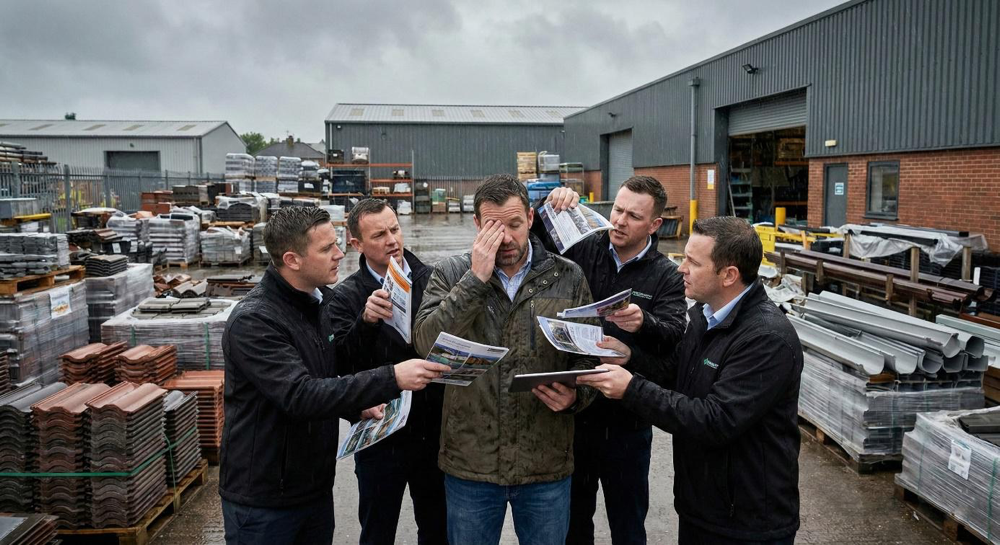
Building a house means making a series of financial and technical decisions in a short time. Choosing and costing the roof is one of the most important.
It is an investment for decades, but also a stage when many clients begin to feel confused.
Can you handle this stage calmly and rationally? Yes, provided the roof quotation follows an organised process rather than responding to pressure from offers.
Why does choosing a roof covering become confusing?
Most clients start online. They compare clay tiles, concrete tiles and metal tile-effect roofing. They read about warranties, technical specifications and special offers.
The problem is that every option looks good. Each has its advantages.
The more information there is, the harder it is to decide.
Next come visits to wholesalers. This introduces another factor: different quotations and different interpretations of what is “standard”.
As a result, the client receives several quotations that are difficult to compare because they differ in scope and level of detail.
Why is the price per m² alone not enough?
The first question is often:
“What does roofing cost per square metre in 2026?”
That is understandable, but oversimplified.
A reliable roof quotation should include:
the main covering
membranes and underlay layers
system accessories
metal flashing
ventilation components
warranty documents
Price differences between quotations very often arise because some components have been omitted or simplified.
Comparing only the final price can therefore lead to the wrong conclusions.
What should a professional roof quotation process look like?
In our experience, an effective process has three stages.

1. Reviewing the design and local conditions
Every roof is different. What matters is:
structural complexity
roof pitch
number of details
building location
In Pomorze, wind conditions and air humidity are additional factors. These affect material recommendations.
2. Establishing the client’s budget
The budget is not a taboo subject.
It is the starting point for discussing realistic solutions.
Without this information, it is easy to suggest options the client cannot afford, causing frustration.
3. Narrowing the choice
Rather than presenting a dozen or so models, it is better to focus on two or three solutions suited to the design and budget.
Limiting the number of options does not reduce the choice.
It improves its quality.
Sales pressure – how can you recognise it?
The construction market is competitive. Special offers and discounts are normal.
However, warning signs can include:
being asked to decide immediately,
incomplete documentation,
paperwork put off until “later”,
a discussion focused solely on price.
For a roof, purchase documents and the completeness of the system directly affect the subsequent warranty.
Saving a few per cent should not mean losing the security of your investment.
Specialist knowledge matters
Choosing a roof is different from buying standard building materials. It is a structural and visual element that affects the durability of the whole building.
It is therefore worth working with a company that specialises in roofs rather than treating them as one of many product categories.
Ambit has focused on roof coverings for 34 years. More than 30 000 completed roofs provide the experience to anticipate problems before they arise.
This means:
more accurate quotations,
a better choice of materials,
less risk of costly changes during construction.
Can obtaining a roof quotation be a calm stage of the build?
Yes, provided:
the process is organised,
the options are limited to sensible solutions,
decisions are made without time pressure,
the scope of the quotation is completely clear.
The roof then stops being a source of stress.
It becomes a predictable part of the construction plan.
Conclusion
Costing a roof in 2026 should not simply mean asking for the lowest price per square metre.
It is a process of reviewing the design, budget and actual conditions in which the building will be used.
The better organised the process, the lower the risk of a poor decision.
If you are choosing a roof covering and want a calm, informed quotation process, contact the Ambit team.
A conversation is the first step towards a good decision.
Questions about your roof?
An adviser will review your plans and choose materials to suit your budget.
About the author
| Adam Zielonkowski | He has been involved in roofing since childhood, growing up in a family business selling roof coverings. From an early age, he learnt about the industry in practice, from unloading tiles to visiting building sites and manufacturers’ factories, including Fakro. His knowledge of roofs comes from experience rather than catalogues. For over 20 years, he has worked professionally in roof coverings as an entrepreneur and roofing market strategist. He works with roofers, contractors and manufacturers of tiles, roof windows and gutter systems, combining operational experience with market knowledge. He helped establish nationwide buying groups, including 4D Grupa – an integrated network of roofing wholesalers, giving clients access to proven products and competitive terms. Today, this experience helps clients make informed decisions when choosing durable, safe roofs. |