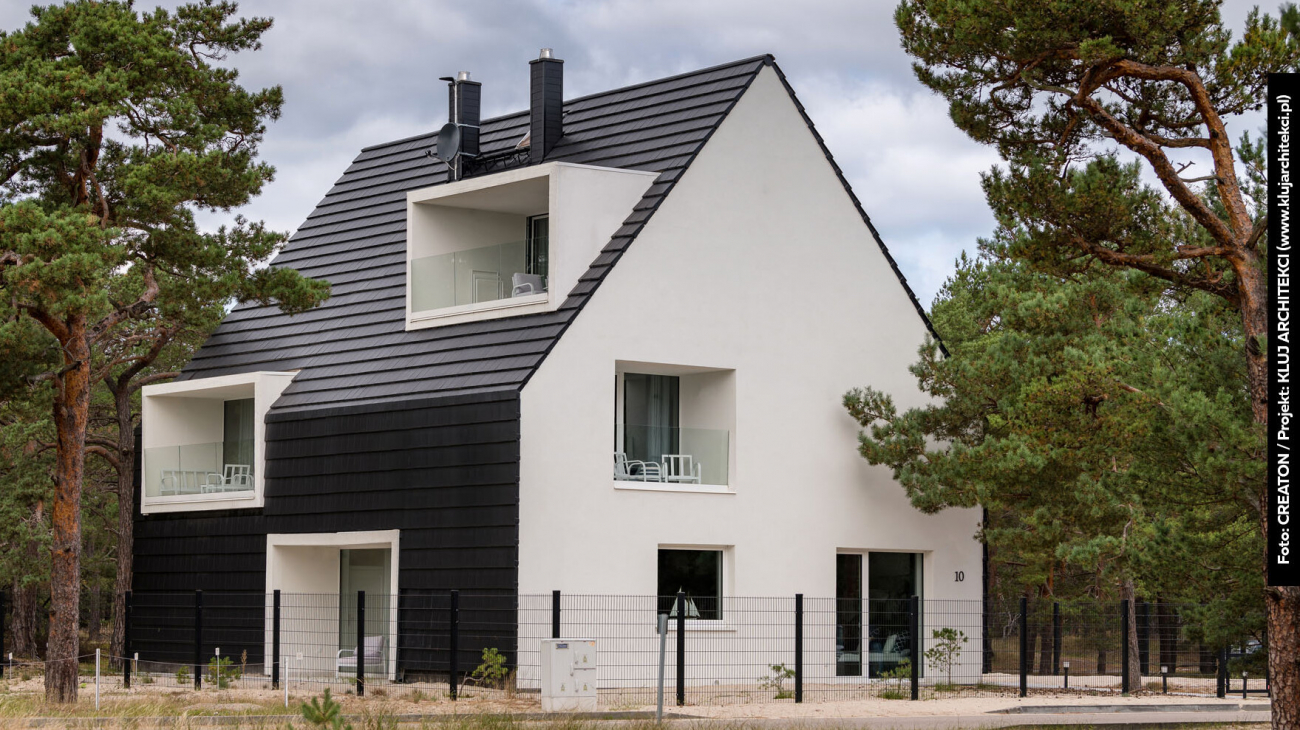
What are the roofing trends in 2026 – what are people choosing and why?
In 2026, a roof should look understated and modern without dominating the whole building. This is most evident in colours and finishes: grey, graphite and anthracite dominate, usually with a matt finish. It is a safe choice that suits white façades as well as timber or modern render in sandy and grey shades.
Another clear trend is the shape: flat tiles and an even, clean roof surface associated with a well-designed house. A third topic appearing more often in conversations is reducing roof heating in summer.

Colour and finish – graphite and matt as the new standard
A dark, muted roof has become a choice intended to last for years. Matt matters because it gives the building an elegant, understated appearance, without the shine that calls for a very consistent architectural approach.
Classic red and curved profiles are still available, but more often as a deliberate choice for traditional houses than as the dominant trend. In practice, when a client asks what people are choosing now, the answer is usually graphite or anthracite, a flat profile and a matt finish.
Shape – flat tiles and larger formats
Flat tiles have become shorthand for a modern house. They create an even surface, allowing the roof to take a supporting role. Larger formats are also attracting more interest, reducing the number of divisions across the roof surface and speeding up installation.
Remember, however, that on complex roofs with valleys, dormers or numerous penetrations, the final result depends mainly on the quality of the details and the team's experience, rather than the tile model alone.
“Cool roof” – a cooler roof in practice
Building overheating is becoming a more prominent topic in 2025–2026. In practice, this offers two approaches: radiation-reflecting coatings on concrete tiles or lighter clay tiles with higher reflectivity.
This is still not a mainstream choice, but clients with habitable lofts increasingly ask about these solutions. One point must be clear: tiles alone cannot replace good insulation and ventilation. They may improve comfort, but cannot solve a structural problem.
Prices in 2026 – where does the difference really arise?
The most common mistake when comparing roof tiles is to compare the price per m² of the basic product and consider the matter settled. Yet a roof is a complete system.
Accessories, flashing, roof access components, membranes and labour add to the cost. This is why clay tiles can be considerably more expensive in one case, while in another the difference between concrete and clay almost disappears, especially when comparing models with a similar visual standard.
The most sensible approach is to compare two or three specific systems in the same colour and finish and calculate the total roof cost, rather than just the tile price.
Appearance and “prestige” – what really creates a premium result?
In 2026, prestige does not automatically depend on whether the tiles are clay or concrete. The perception of quality comes mainly from the result: an even roof surface, consistent colour, carefully finished details around chimneys and windows, and attractive flashing.
Clay tiles more often create a premium impression through their finish: engobe or glaze. Concrete tiles do so through geometry and coating quality in modern, flat models. In practice, a client senses quality from the roof's overall appearance rather than the material's name.
How tiles look after years – the realities of the climate
The greatest enemy of a roof's appearance in Poland is its surroundings rather than the material. Shade, a north-facing roof slope, nearby trees and high humidity encourage biological growth: algae, lichens and moss.
In Pomorze, the topic arises more often because of the climate. Growth appears mainly in places that dry most slowly and receive less ventilation. It is a natural process that can affect both concrete and clay.
Paying extra for enhanced surfaces, such as engobe, glaze or better concrete tile coatings, does not guarantee freedom from moss, but usually means slower visual ageing and easier cleaning. More clients are now paying for precisely this predictability.
Warranty claims and disappointment – where do problems come from?
There are no publicly available, comparable statistics on warranty claims by tile model and colour. Installation experience nevertheless suggests that the material itself rarely causes problems.
The most common causes are a poor match to the plot's conditions, mistakes in the details and excessive expectations that the appearance will remain unchanged for years.
The best protection is a well-chosen system and careful workmanship. Even the most expensive tile cannot compensate for poorly installed flashing or inadequate roof ventilation.
Pomorze – wind, moisture and salt
In coastal areas, roofs face more demanding conditions. Strong winds, high humidity and, closer to the sea, salt spray make fixings, connector quality and correctly finished roof edges more important.
This is an argument for a sound system and uncompromising installation rather than any particular material. In a damp climate, paying extra for a better surface finish is more often justified because the roof keeps a consistent appearance for longer.
Recommendations for 2026 – if… then…
If the roof is simple and your budget matters, compare two or three specific systems with a similar finish standard and calculate the cost of the whole roof.
If the design is complex, prioritise details and labour: this is where costs and problems can most easily arise.
If the plot is shaded and damp, consider a better surface finish.
If you are close to the sea, pay particular attention to fixings and metal components.
Above all, a roof in 2026 should be predictable in appearance and technical performance, both on handover day and after several years of use.
FAQ
Is it better to buy concrete or clay roof tiles in 2026?
That depends on the effect you want, the plot's conditions and the finish standard. A premium result is now possible with either material, and price differences often change when the whole roofing system is considered.
What are the most fashionable roofing choices in 2026?
Grey, graphite and anthracite, mainly in matt finishes, and flat tile profiles are the most popular choices.
Will the tiles look good after 10 years?
Shade, moisture and nearby trees have the greatest influence. In difficult conditions, consider better surface finishes, such as engobe/glaze or stronger coatings, because they slow visual ageing and make cleaning easier.
I live in Pomorze – what should I watch out for?
Fixings and details because of wind, the choice of metal components because of moisture/salt closer to the sea, and the risk of biological growth in shaded areas.
Questions about your roof?
An adviser will review your plans and choose materials to suit your budget.
About the author
| Adam Zielonkowski | He has been involved in roofing since childhood, growing up in a family business selling roof coverings. From an early age, he learnt about the industry in practice, from unloading tiles to visiting building sites and manufacturers’ factories, including Fakro. His knowledge of roofs comes from experience rather than catalogues. For over 20 years, he has worked professionally in roof coverings as an entrepreneur and roofing market strategist. He works with roofers, contractors and manufacturers of tiles, roof windows and gutter systems, combining operational experience with market knowledge. He helped establish nationwide buying groups, including 4D Grupa – an integrated network of roofing wholesalers, giving clients access to proven products and competitive terms. Today, this experience helps clients make informed decisions when choosing durable, safe roofs. |